5 Reasons Wooden Sunglasses Are Made for the Australian Lifestyle
Australia is not a gentle place to be a pair of sunglasses. The UV index here regularly hits "extreme." Summer heat in a parked car can melt cheap plastic frames. Beach days mean salt spray and sand. Bush hikes mean sweat, sticks, and getting dropped on rocks. And the average Australian spends more time outdoors than just about any other developed country on earth.
A pair of sunglasses bought for those conditions needs to be built differently from sunglasses bought for a London commute. Here are five specific, practical reasons wooden sunglasses outperform plastic for the way Australians actually live.
1. They're built for Australia's UV environment
Australia and New Zealand share the highest average UV levels of any developed nations. The sun here doesn't politely fade — it bleaches, cracks, and destroys. Any pair of sunglasses bought for Australian conditions needs to do two things well: block UV from reaching your eyes, and hold up to long-term sun exposure without falling apart.
Vilo lenses are polarised, UV400, and meet AS/NZS 1067.1:2016, the Australian sunglasses standard. UV400 means the lens blocks UV radiation up to 400 nanometres in wavelength, which covers both UV-A and UV-B. That's the full range of sun damage your eyes need protection from.
This is also where the cheap servo sunglasses fall down. Many don't meet the Australian standard at all. A dark tint without proper UV blocking is actively worse than no sunglasses. Your pupils dilate behind the dark lens and let more UV through than they would in bright light.
The frame side of the equation matters too. Cross-laminated hardwood doesn't degrade under prolonged UV exposure the way some plastics do. The grain you see when you buy the sunglasses is the grain you'll see in five years.
2. They're light enough for long days outside
The average Australian wears their sunglasses for hours at a time. Beach days. Road trips. Cricket at the park. Surfing. Camping. Backyard barbecues that stretch from lunch into the late afternoon.
Wooden frames are about 33% lighter than equivalent plastic frames.
That difference is invisible on paper and unmissable on your face. After eight hours, light frames leave no marks on the bridge of your nose, no pressure points behind your ears, and no headache. Heavy frames do all of the above.
The other comfort win is breathability. Wood breathes, it doesn't trap heat against your skin the way plastic does. On a 38°C day at the cricket, that genuinely matters.
This is the most-mentioned thing in our customer reviews. People don't write reviews about sustainability statistics. They write reviews about how the sunglasses feel after the third hour at the beach.
3. They survive an Australian outdoor lifestyle
There's a difference between sunglasses that look good in a photoshoot and sunglasses that survive a real Australian summer.
Cross-laminated wood, the construction Vilo uses for our full-wood range, is built in layers running in opposing grain directions. It's the same principle that makes plywood stronger than solid timber of the same thickness.
What wood doesn't love: prolonged saltwater immersion or being left in a swimming pool. The lenses are also still plastic, so the same lens-care rules apply, don't wipe with your t-shirt, don't leave them face-down on concrete.
Within normal use, including bush walking, surfing (dry storage), driving, fishing, and daily wear in coastal conditions, our sunglasses are built to last for years. Backed by our 12-month warranty and 200-day accidental damage cover, because we know real life happens.
4. They align with how Australians actually think about the environment
Australia has a complicated relationship with sustainability. We have some of the highest per-capita waste rates in the world, and we also have a strong cultural attachment to the outdoors that makes environmental damage personally visible. Bushfires, bleached reefs, microplastics on beaches.
Most Australians aren't activists. They're practical. They want sustainable choices when those choices are also functional, durable, and not preachy.
That's where wooden sunglasses fit. The environmental story isn't separate from the product:
- The frame is renewable. Wood grows back, unlike petroleum.
- The frame is biodegradable. Once you remove lenses and hinges, it composts at home.
- The frame doesn't shed microplastics into your skin and the environment during wear.
- The packaging is home compostable. Your worm farm will appreciate it.
- The recycling program accepts old sunglasses of any brand, so a Vilo purchase is also a way to retire an old pair without sending it to landfill.
You're not buying a hairshirt. You're buying functional sunglasses that happen to leave a smaller mark on the country you live in.
5. They look like they belong here
This one is partly aesthetic and partly cultural.
Plastic sunglasses can be made to look like anything, neon, leopard print, mirror chrome. They're a fashion blank canvas. That has a place, but it doesn't always read as "Australian."
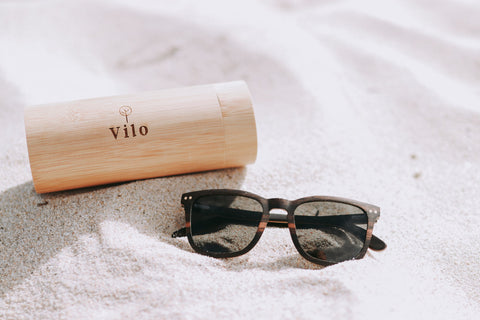
Wooden sunglasses look like a natural object. The grain runs through the frame like the grain runs through a piece of driftwood on a beach in Margaret River. The colours come from the wood species, walnut, zebrawood, bamboo. Not from a paint job. Each pair is slightly different because no two pieces of timber are identical.
It's a quieter look. It pairs as easily with linen shirts and beach gear as it does with workwear or a wedding suit. It reads as confident-without-trying, which is, broadly, the Australian aesthetic when it's at its best.
And because every pair is unique, you don't run into someone wearing the identical sunglasses at a music festival. That's a small thing, but it matters.
What this means in practice
If you spend most of your time indoors in air-conditioned offices and only wear sunglasses on weekends, almost any reputable pair will do. The lifestyle case for wood doesn't apply as strongly.
If you're outdoors a lot, drive long distances, spend time on or near the water, or just don't want to feel your sunglasses on your face by the end of the day, wood is built for that life. The weight, the heat tolerance, the durability, and the longer lifespan all compound.
Most of our customers find that once they've worn wooden sunglasses for a week, plastic ones feel like they're sitting on top of their face instead of with it.
Shop our wooden sunglasses range → See the top-reviewed picks →
FAQs
Are wooden sunglasses suitable for surfing or swimming? Light splashes and salt spray are fine. Prolonged immersion in salt water or chlorinated pools isn't recommended. Repeated wet/dry cycling can affect any wood product. Use a strap and treat them like quality eyewear, not waterproof gear.
How long do wooden sunglasses last? With normal daily use, several years. The biggest risk to any pair of sunglasses isn't material failure, it's losing them. All Vilo sunglasses come with a 12-month warranty and 200-day accidental damage cover.
Are wooden sunglasses good for sport? For most sports, beach, hiking, driving, cricket, fishing, golf, yes. For high-impact wraparound sports like cycling or trail running where you need maximum coverage and minimum weight, dedicated sport sunglasses may be a better fit.
Related reading: Wooden vs Plastic Sunglasses | Sustainable Sunglasses: The Honest Buyer's Guide | Best Sunglasses for Driving in Australia